




Free Shipping on Most Orders Within the Continental U.S. (Excludes AK/HI)
30-Day Returns
Alloy Steel Frames Built to Published Load Ratings
Secure Checkout on Every Order
Built for Serious Spaces
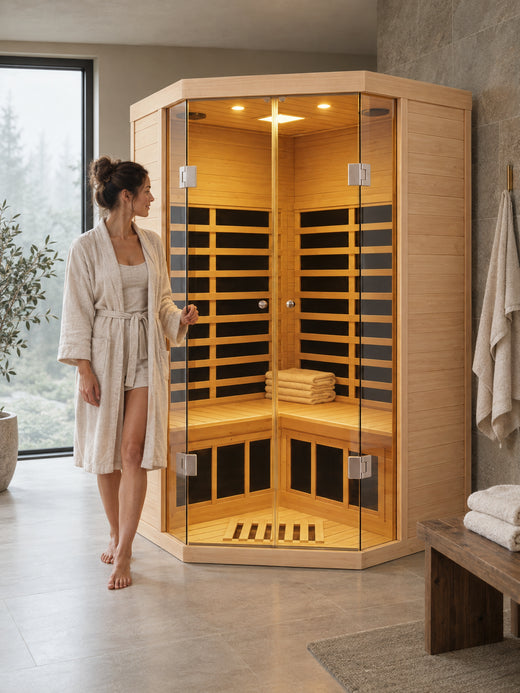
Sportivon carries golf simulators, Smith machines, and infrared saunas selected for measurable build quality — alloy steel frames, carbon mica heating panels, HD impact screens — not category trends. Every order ships free within the Continental U.S. (excludes AK/HI) with full tracking included. Questions before or after purchase reach our team directly at support@sportivon.com or (817) 723-9552.
Questions Worth Answering
For most compound barbell work, a machine rated at or above 1,000 lb provides adequate margin under real training loads. The figure on the spec sheet should reference the total system capacity, not just the bar guide. Check whether the rating covers both the Smith bar and any integrated cable or pulley components separately.
For movements where the fixed vertical path is an advantage — squats, presses, shrugs — a guided bar performs the intended function cleanly. For movements that depend on lateral bar travel or independent stabilisation, a free barbell remains the appropriate tool. Many setups combine both; the Smith machine handles the primary loaded patterns while a separate rack handles the rest.
A combined Smith machine with cable crossover typically occupies a footprint between 7 and 9 feet in length and 4 to 5 feet in width, with ceiling clearance requirements of 7 to 8 feet depending on the pulley height. Measure your space with those numbers in hand before ordering, and account for a working clearance of at least 3 feet on each active side.
Smith machines ship free on most orders within the Continental U.S. — Alaska and Hawaii are excluded. If the machine is not the right fit, our 30-Day Return policy applies; visit the Return Policy page for the full process and conditions before initiating a return.
About Our Smith Machines
A Smith machine constrains the barbell to a fixed vertical — or near-vertical — track, removing lateral drift from the movement and allowing the lifter to load compound patterns without a spotter managing bar path. The guide system handles stabilisation in one plane, which lets a solo athlete concentrate force through the intended range of motion. Most units built for home or club-adjacent use integrate a pulley system and attachments for cable work, extending the functional surface of a single frame considerably. When evaluating this category, the critical figures are frame material and gauge, total load capacity across both the Smith bar and cable system, and the quality of the guide bearings or linear bushings — smooth travel under load distinguishes a machine that trains well from one that merely occupies space. Ceiling height, floor footprint, and working clearance on each side are practical considerations that spec sheets frequently understate. A well-specified machine in this category is a long-hold piece of equipment; the decision is worth the time to read past the marketing summary.

